

In food production, contamination (dirt) is a major challenge. Dirt in the form of product residues consists of many different components, and if the process involves heating or cooling, it becomes even more challenging to clean the plant. Most food plants must be cleaned in place between production cycles. This type of cleaning is called Clean-in-Place and is often abbreviated as CIP.
If the plant is not completely clean, microbial growth may occur—microorganisms such as bacteria and fungi. To ensure microbial growth is avoided and that food handling is safe and of high quality, the equipment must be cleaned and disinfected continuously.
The four factors of cleaning
When cleaning food production plants, there are several factors that affect the result. These factors are mechanical action, temperature, chemical concentration, and time. How these factors interact and influence cleaning processes is illustrated in a model called Sinner’s Circle.
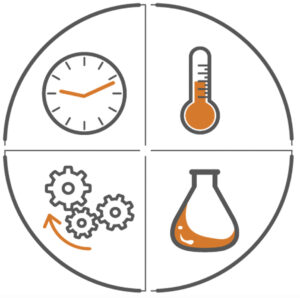
Mechanical action can, for example, be high-pressure rinsing or brushing; chemical concentration affects the chemicals’ ability to dissolve dirt. Temperature during cleaning is important because dirt dissolves more easily and can be removed from surfaces more readily at higher temperatures. The duration of the cleaning process also affects the result.
The factors interact
The four factors function like slices of a pie in a circle. If one of them is reduced (for example, if chemicals cannot be used), one or more of the others must be increased to achieve the same result (for example, more mechanical action for a longer time). When all four factors are met, you can ensure quality-assured food production. It is also equally important to continuously follow up on cleaning results and keep the equipment in good condition through effective maintenance.
The checklist below is a good path to achieving good cleaning results for food plants.
- Pre-rinse with cold water. This removes large particles and product residues so they do not obstruct, clog, and impair cleaning. It also allows the chemical solution to reach closer to the surfaces that need to be cleaned.
- Pre-rinse with hot water. Dirt has different properties at different temperatures. At higher temperatures, it dissolves more easily and releases more readily from the surfaces that need to be cleaned. Temperature is particularly important for dried-on product residues and microbiological residues. Put simply, the higher the temperature used, the faster the process.
- Chemical cleaning. Once visible dirt has been removed from the plant, the chemical solution has the best conditions to do its job. It penetrates behind and dissolves the invisible biofilm of product residues that remains after the pre-rinses.
- Rinse with hot water. This step removes the dissolved product residues that may still remain in the plant. It also removes residues of the chemical solution. Temperature and water pressure are crucial in determining how long this should continue.
- Rinse with cold water. This cools down the plant and also removes the very last residues of the chemical solution. Cooling is important because warm surfaces attract moisture from surrounding surfaces that have not yet been cleaned, which can contaminate the newly cleaned surface. This would entail a risk of microbial growth.
- Disinfecting chemical cleaning. The final step ensures that the equipment is sterile. Disinfectants make it difficult for microbial growth to start.
Chemicals
Cleaning chemicals ensure that dirt and product residues dissolve and can be rinsed out. In the food industry, there are many different substances and combinations. Without chemicals
it is simply not possible to reach certain bacteria. Anaerobic and aerobic bacteria are everywhere and are highly capable of finding surfaces to attach to.
In food handling and CIP, alkaline chemical solutions are required to dissolve organic material. Inorganic material can easily be removed with water, but
organic residues require a concentration of alkaline or chlorine-based chemicals.
In general, caustic-based chemicals are recommended. Caustic soda is alkaline and has good properties for dissolving product residues. However, caustic soda may instead have difficulty removing taste and odour on
the inside of plants. Disinfectants with foam-based chemicals can be used directly on the plant’s external surfaces but usually do not reach the inside of pipes and other difficult areas.
It is important to choose the right disinfectant chemical. It is important to select the right chemical based on the materials used in the equipment. Seals and other machine parts are affected differently by different chemicals. For example, chlorine can cause corrosion even on certain types of stainless steel. Many factors influence the choice, and a good recommendation is to consult the chemical supplier.
If you want to know more about how we at Qestio can help you analyze the potential savings in your production facility and support you in implementing the necessary changes – contact us.
